
Load charges no longer change on their own. Editing a load’s dates, miles, weight or stops won’t reprice it. Charges only update when you click Calculate Payments or select a customer rate sheet or lane, and you’ll see exactly what changed before you save.
What’s new
- Calculate Payments button to update charges whenever you’re ready.
- Status column shows whether each charge is new or changed.
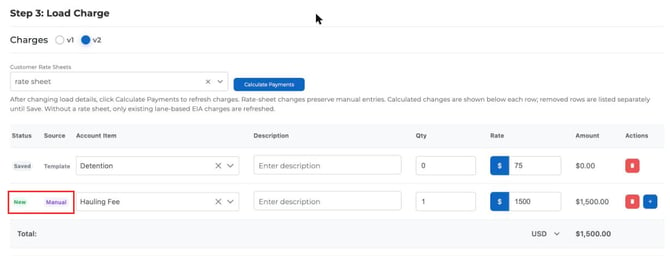
- Source column shows where each charge came from: Manual (typed in) or Template (from a rate sheet).
- Applying a rate sheet only updates Template charges. Anything you entered manually stays put.
- A short note under each row that was added or changed.
- A Removed charges list showing what will be deleted when you save.
Step 1: Open the load’s charges
Open the load from Dispatch and scroll to Step 3: Load Charge.
Step 2: Choose a rate sheet
Pick the customer’s rate sheet in Customer Rate Sheets. Each charge row shows:
- Status: Saved (already on the load), New (added, not saved yet) or Changed (edited, not saved yet).
- Source: Template (from the rate sheet) or Manual (everything else, including typed-in charges, EDI, PDF rate cons and customer lanes).
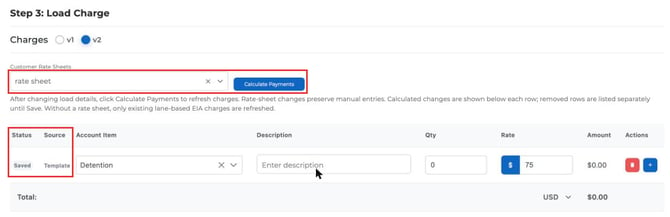
Click the + button to add a row, then choose the Account Item and enter the Qty and Rate. The row is marked New and Manual.
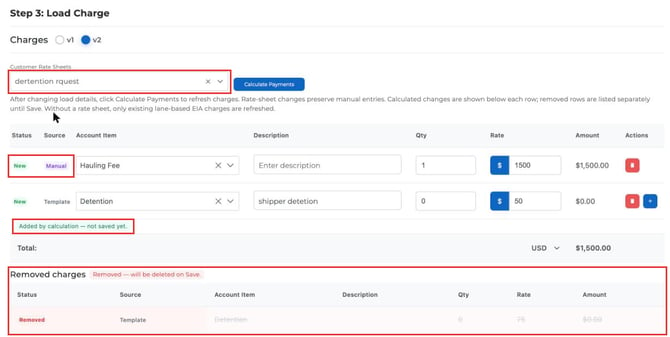
When you select, switch or clear the rate sheet, only the Template rows are updated. Your Manual rows are not touched.
- Rows added by the new rate sheet show "Added by calculation — not saved yet."
- Saved rate sheet rows that no longer apply move to the Removed charges table. They don't count toward the total and are deleted only when you click Save.
Tip for EDI and PDF loads: charges that came in from EDI or a PDF rate con count as Manual. You can apply a customer rate sheet to add accessorials like detention without wiping out the imported charges.
If you change load details such as dates, miles, weight or stops, click Calculate Payments to reprice the rate sheet rows. Any row that changes shows a note underneath, for example "Rate 65 → 50."
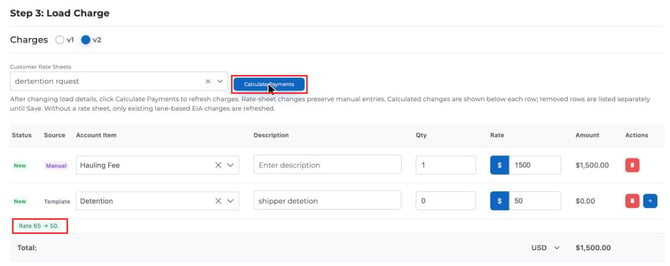
Check the notes and the Removed charges table, then click Save or Save & Close. Nothing is changed on the load until you save. If you close the load without saving, the charges stay as they were.
Good to know: Without a rate sheet selected, Calculate Payments only refreshes existing lane-based fuel surcharge (EIA) charges. For automatic pricing, we recommend setting up a customer rate sheet instead of using customer lanes.